Recession Core: Why the Smartest Businesses Get Quieter When the Market Gets Loud
Beatrice Sterling, MBA · · 4 min read
The brands winning right now aren't the ones shouting the hardest. They're the ones who understood something the market forgot.
There is a particular kind of business that thrives in a downturn.
It doesn't discount. It doesn't panic-post on social media. It doesn't pivot its entire offering every quarter in response to headlines. It gets quieter, more deliberate, and somehow — counterintuitively — more visible.
This is not luck. It is not resilience in the motivational-poster sense of the word. It is strategy. Specifically, it is the strategy of understanding what consumers actually do when economic pressure arrives — and positioning accordingly before everyone else figures it out.
What "Recession Core" Actually Means
The term emerged from fashion — a cultural shift toward muted tones, quality basics, and conspicuous restraint. Think Totême over Gucci. A $400 cashmere jumper worn for a decade over a $2,000 statement piece worn twice.
But what started as an aesthetic has become a consumer psychology framework that applies far beyond clothing.
Recession Core, at its core, is the market's collective decision to reward durability over novelty, substance over spectacle, and trust over trend.
For businesses, this has profound implications. Because most marketing — particularly in the small business space — is built entirely on the opposite: novelty, spectacle, and trend.
What the Data Actually Shows
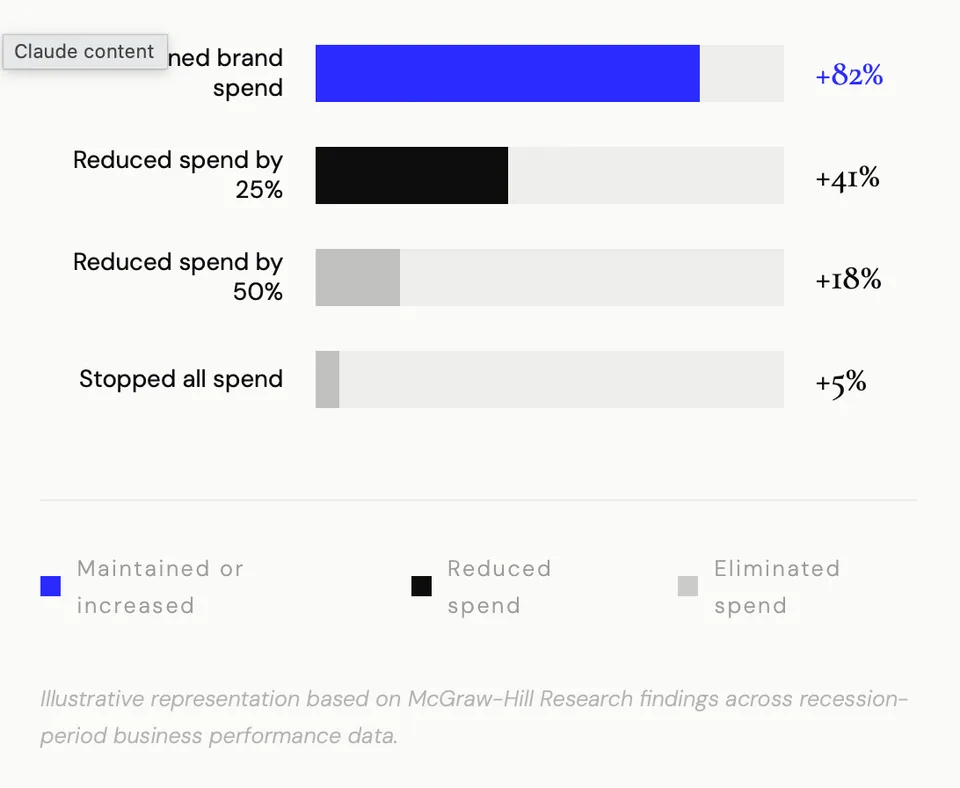
Research consistently demonstrates that businesses which maintain or increase their brand investment during economic contractions emerge with significantly higher market share than those that cut.
The mechanism is straightforward. When competitors retreat — reducing ad spend, scaling back content, cutting the "non-essential" brand budget — the cost of attention drops. The noise floor lowers. Suddenly, a business that was previously fighting for visibility against thirty competitors is fighting against ten.
This is what strategists call the Share of Mind void. The competitors who left didn't take their customers with them. Those customers still have needs. They are still searching, still deciding, still buying — just more carefully. The business that remained visible, credible, and consistent is the one they find.
McGraw-Hill Research studied 600 companies across two recessions and found that those who maintained advertising through the downturn achieved significantly higher sales growth both during and after the recession compared to those who cut spending. The businesses that went quiet handed market share to the businesses that stayed present.
This pattern has repeated across every significant economic contraction on record.
The Three Shifts Happening Right Now in Consumer Behaviour
From impulse to intention.
Consumers are making fewer, more considered purchasing decisions. They are researching longer, comparing more carefully, and placing greater weight on trust signals — reviews, referrals, perceived stability, and brand coherence. A business with a clear, consistent brand identity is disproportionately rewarded in this environment because it reduces the perceived risk of a purchasing decision.
From cheap to considered.
The budget end of most markets is being hollowed out by the cost of living pressure hitting consumers. But the premium end — businesses that offer genuine quality, clear positioning, and a credible value story — is holding. What is collapsing is the undifferentiated middle: the businesses that are neither cheap enough to win on price nor premium enough to win on value. If your positioning is unclear, a tightening market will expose it faster than anything else.
From transaction to relationship.
Acquisition costs are rising across every channel. Businesses that built genuine client relationships — through consistent communication, reliable delivery, and authentic brand presence — are retaining customers that purely transactional businesses are losing. The economics of retention have always been better than acquisition. In a downturn, the gap widens dramatically.
What This Means for a Small Business With a Limited Budget
The instinct, when cash is tight, is to cut the brand budget first. Marketing feels optional in a way that rent and payroll do not.
This instinct is understandable. It is also one of the most reliably damaging decisions a small business can make in a contracting market.
The businesses that will look back on 2025 and 2026 as the years they broke through are not the ones with the largest budgets. They are the ones that made deliberate, consistent choices about how they showed up — even when it was uncomfortable, even when the ROI wasn't immediate, even when the market was telling them to hide.
Here is what that looks like practically, for a business with limited resources:
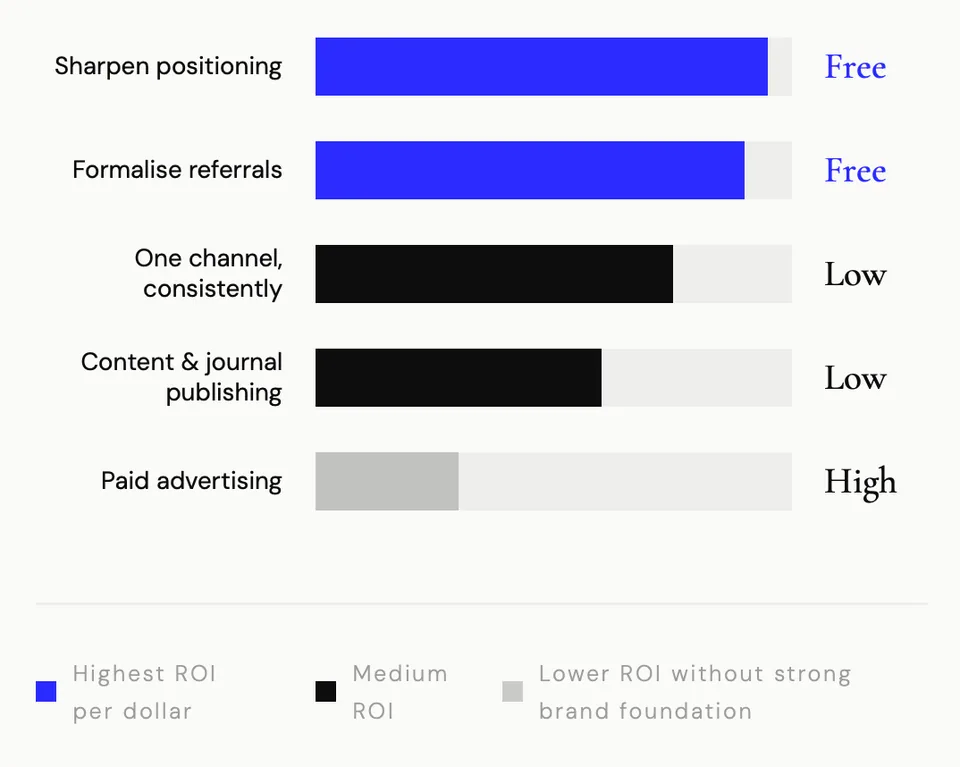
Pick one channel and dominate it.
Trying to be everywhere with no budget produces nothing. Committing to one channel — whether LinkedIn, Instagram, Google, or email — and showing up with genuine consistency and quality produces compound returns over time.
Invest in your positioning before your promotion.
If you are unclear about what makes your business the right choice for a specific type of client, no amount of advertising will fix it. Clarity of positioning is free. It costs only the discipline to think it through properly.
Let your existing clients do your marketing.
A structured referral process — even a simple one — costs almost nothing. In a market where trust is the primary currency, a referral from an existing client is worth more than any paid channel. Most businesses have a completely unstructured approach to generating referrals. Formalising it takes an afternoon.
Show up when others go quiet.
This is the Recession Core play in its simplest form. Publish the article. Send the email. Post the project. The moment your competitors stop showing up is the moment your visibility doubles at the same cost.
The Quiet Confidence of Businesses That Last
There is something recognisable about the businesses that endure economic cycles. They don't thrash. They don't reinvent themselves every six months. They have a clear sense of what they are, who they serve, and why that matters — and they communicate it consistently regardless of what the market is doing.
This is not passivity. It is the highest form of business discipline: knowing what you stand for clearly enough that external noise doesn't cause you to abandon it.
The market is shifting. Consumer behaviour is changing. The rules of attention and trust are being rewritten in real time.
The businesses that understand this — and position accordingly — won't just survive the current climate.
They will own the next one.
Studio Orris is a Brisbane-based business studio serving founders across Australia. We work across brand identity, digital presence, business strategy, and people management.
 Return to Insights →
Related Insights
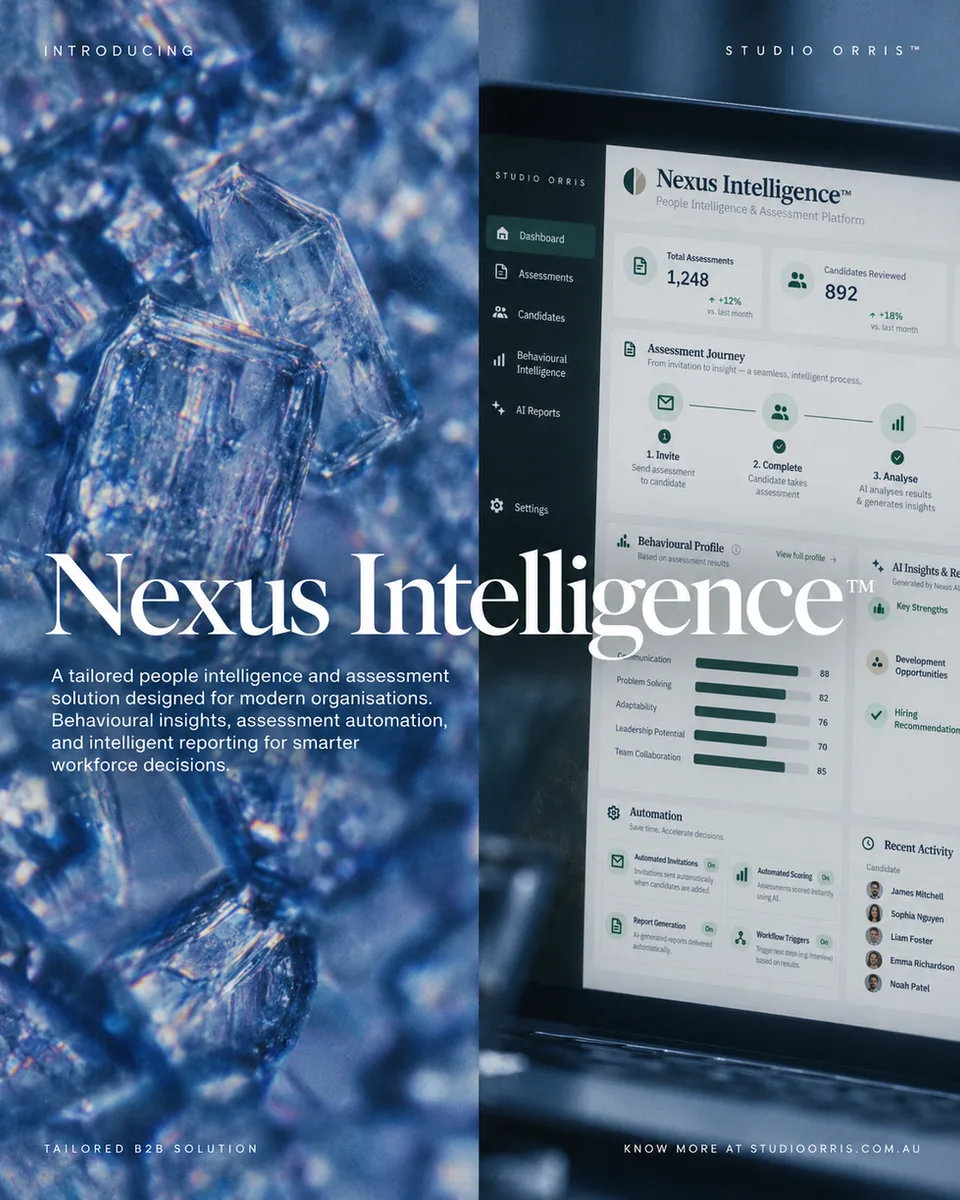
Studio Orris Launches Nexus Intelligence™ for Smarter People Decisions
Studio Orris · 10 September 2026
The Insolvency Plateau
Beatrice Sterling, MBA · 7 September 2026

Built Differently, Recognised Locally: Outside the Box Wins at the 2026 Brisbane City Local Business Awards
Studio Orris · 30 August 2026