The Founder's Paradox: Why the Person Building the Business Is Usually the Last One Taken Care Of
Christian Voss, PhD · · 5 min read

A note on the particular loneliness of building something — and what it actually costs.
There is a version of the founder story that gets told often.
The early mornings. The late nights. The sacrifice. The grind. It is told with a kind of pride that is completely earned — because building a business from nothing is genuinely hard, and the people who do it deserve recognition for what it costs them.
But there is another version of the story that gets told far less often. The version where the founder is also the HR department, the finance team, the marketing manager, the sales director, and the person who fixes the printer.
The version where the business is growing but the person running it is quietly, systematically depleting — financially, mentally, and structurally.
This version is less photogenic. It doesn't perform well on LinkedIn. But it is the version that is closer to the truth for most of the founders we work with.
The Structural Problem Nobody Prepares You For
When you start a business, you are given a great deal of advice about products, markets, and funding. You are given almost no advice about the operational reality of being the single point of failure for an entire organisation.
Because that is what a founder is, particularly in the early stages. Every decision routes through you. Every problem lands on your desk. Every relationship — with clients, suppliers, staff, contractors — is ultimately your responsibility to maintain.
This is not a personal failing. It is a structural condition. And it has predictable consequences.
The first is decision fatigue. Research from Columbia University found that the average person makes approximately 35,000 decisions per day. A founder makes a disproportionate number of high-stakes ones — pricing, hiring, client management, strategy — before most people have finished their morning coffee. The cognitive load is not sustainable indefinitely, and the first casualty is usually strategic thinking. The founder becomes reactive, managing what's in front of them rather than building what's ahead.
The second is financial exposure. Most founders significantly underpay themselves in the early years, reinvesting everything back into the business. This is often the right short-term decision.
But it creates a pattern — of treating the business's needs as real and urgent, and the founder's financial needs as optional — that becomes increasingly damaging over time. The business grows. The founder's personal financial position doesn't keep pace. And the resentment that eventually produces is one of the primary reasons otherwise successful businesses stall.
The third is the isolation of expertise. The more specialised and capable you become in your field, the fewer people around you can meaningfully understand what you are dealing with. Your partner is supportive but doesn't know your industry. Your friends are encouraging but can't engage with the nuance of your specific problem. Your team looks to you for direction rather than providing it. And so the decisions — the real, consequential ones — get made alone, in the absence of the perspective that would make them better.
What the Data Shows About Founder Wellbeing
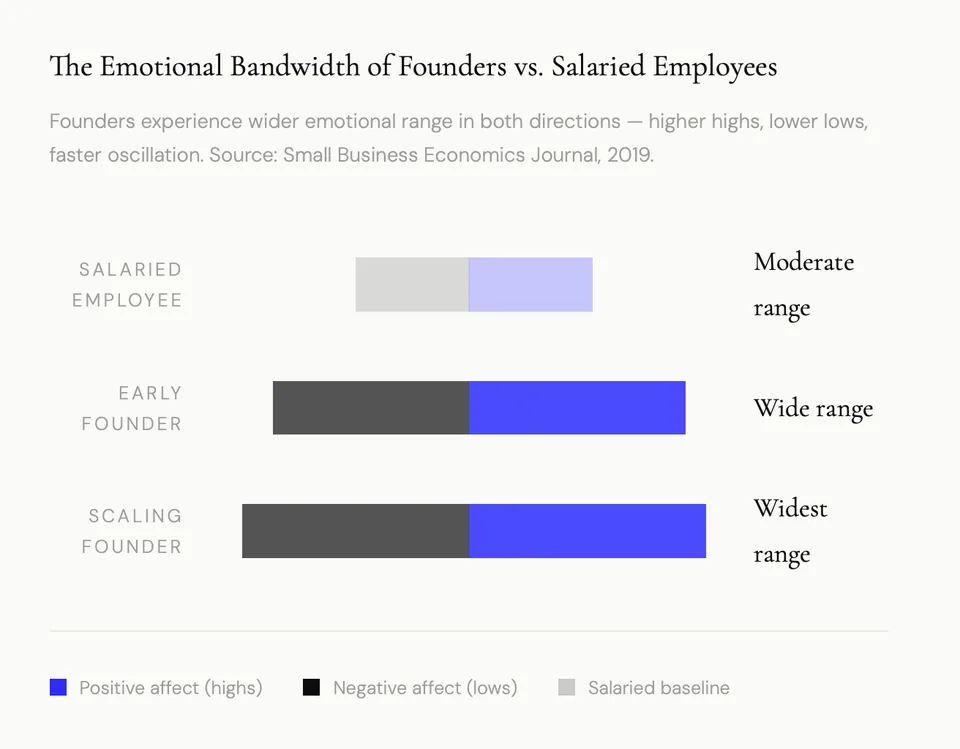
A 2019 study published in the Small Business Economics journal found that entrepreneurs report significantly higher levels of both positive affect and negative affect than salaried employees — meaning the emotional range of running a business is simply wider in both directions.
The highs are higher. The lows are lower. And the oscillation between them is faster and less predictable than most people who haven't done it can understand.
A separate study by Michael Freeman at UC San Francisco found that 72% of entrepreneurs self-reported mental health concerns. Nearly half reported experiencing depression. These are not people who failed. These are people who were building — often successfully — while carrying a weight that the professional conversation around entrepreneurship rarely acknowledges.
This is not an argument against starting a business. It is an argument for building one with better infrastructure — systems, support, and structures that distribute the load more intelligently than a single founder can carry alone.
The Things That Actually Help
Not productivity systems. Not morning routines. Not another framework for prioritisation.
The things that actually reduce the structural load on a founder are simpler and harder than any of those.
Hiring before you're ready.
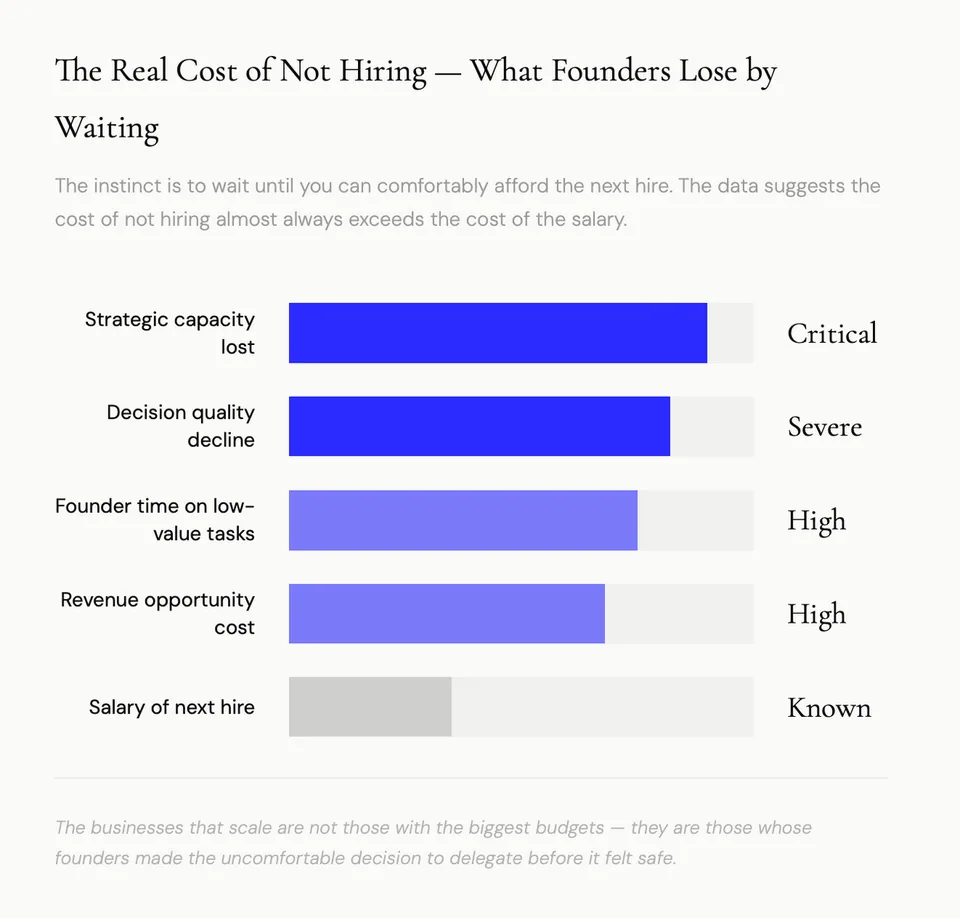
The instinct is to wait until you can comfortably afford the next hire. But the cost of not hiring — in founder time, decision quality, and strategic capacity — almost always exceeds the cost of the salary. The businesses that scale do so because their founder made the uncomfortable decision to delegate before it felt safe.
Separating yourself from the business financially.
Pay yourself a consistent salary, even if it's modest. Draw a clear line between your personal finances and the business's. The psychological clarity this creates — knowing what the business owes you and what you owe the business — is worth more than the amount of the salary itself.
Building systems for the things that drain you.
Every founder has a category of work that is necessary but depleting — the admin, the compliance, the HR, the operational detail. These tasks don't disappear by being ignored. They accumulate, and they extract a cost every time they land on your desk. The founders who build well are the ones who systematise or delegate these things early — not when they're overwhelmed, but before.
Finding genuine peer accountability.
Not a mentor who tells you what you want to hear. Not a business coach with a programme to sell. A peer — another founder at a similar stage — with whom you can be completely honest about what is actually happening. The value of being genuinely understood by someone who is living a comparable reality is difficult to overstate.
A Note on What This Is Really About
This is not a piece about founder wellness in the self-care sense. It is a piece about business performance.
A founder who is depleted makes worse decisions. A founder who is financially stressed takes on the wrong clients. A founder who is isolated misses the perspective that would have changed the outcome. These are not soft concerns. They are material business risks.
The businesses that last — that build genuine value over time and create something worth keeping — are almost never built by founders who sacrificed everything. They are built by founders who understood their own limits clearly enough to build around them.
That understanding is, in its own way, the most important strategic advantage a founder can have.
Studio Orris works with founders across Australia on brand, business strategy, and people management. If any part of this resonated, we'd be glad to have a conversation.
 Return to Journals →
Related Insights

Studio Orris Launches Nexus Intelligence™ for Smarter People Decisions
Studio Orris · 10 September 2026
The Insolvency Plateau
Beatrice Sterling, MBA · 7 September 2026

Built Differently, Recognised Locally: Outside the Box Wins at the 2026 Brisbane City Local Business Awards
Studio Orris · 30 August 2026