The Insolvency Plateau
Beatrice Sterling, MBA · · 9 min read
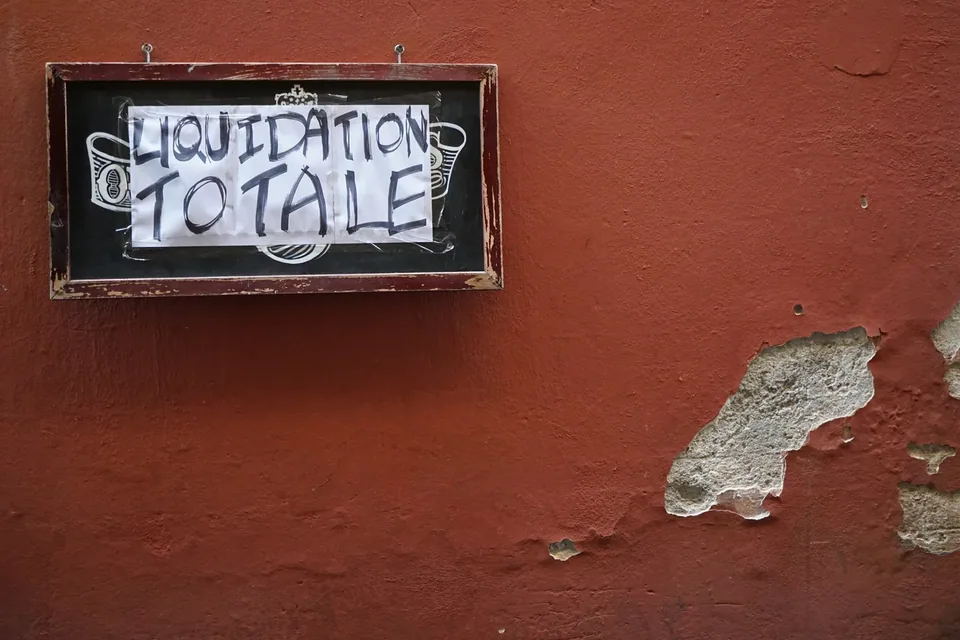
Corporate failures are stabilising — but the conditions driving business distress remain firmly in place.
For the first time in several years, Australia's corporate insolvency headline has improved.
ASIC data for FY2025–26 shows 14,152 companies entered external administration or had a controller appointed for the first time , compared with 14,722 in FY2024–25 — a decline of approximately 4 per cent. Construction remained the largest category, with 3,472 appointments , followed by accommodation and food services with 2,078 .
At first glance, that looks encouraging.
It is.
But it is not the same thing as saying Australian businesses are suddenly operating in an easy environment.
The year before, FY2024–25, the number of companies entering external administration had increased 33.2 per cent , from 11,053 to 14,722. ASIC subsequently described the rise as beginning to moderate after insolvencies had levelled around 1,200–1,300 appointments per month.
Our interpretation is therefore more restrained:
And that distinction should matter to every founder, director and management team.
The numbers behind the headline
The scale becomes clearer when FY2026 is viewed over a longer horizon.
Indicator
Latest evidence
First-time external administration/controller appointments, FY2025–26
14,152
FY2024–25
14,722
FY2023–24
11,053
FY2021–22
4,912
Construction, FY2025–26
3,472
Accommodation & food services, FY2025–26
2,078
Small-business collectable ATO debt, FY2024–25
$35.9bn
Businesses expecting difficulty meeting financial commitments, June 2026
28%
ASIC and insolvency industry data show corporate appointments have almost tripled from the exceptionally low FY2021–22 level of 4,912 to 14,152 in FY2025–26.
But there is an important statistical qualification.
The Reserve Bank says that when insolvencies are measured as a proportion of operating companies , the economy-wide insolvency rate has stabilised at around its longer-run average. Australia has far more registered and operating companies today than it did during previous insolvency peaks.
So the intellectually defensible conclusion is not:
“Australian business has never been in worse shape.”
The evidence does not support that claim.
The more interesting conclusion is:
The absolute number of distressed companies remains exceptionally high, while that distress is concentrated disproportionately in particular industries and smaller enterprises.
That is a considerably more useful story.
Construction is still carrying almost one quarter of the problem
The construction sector illustrates it best.
In FY2025–26, 3,472 construction companies entered external administration or had controllers appointed for the first time. That was slightly below 3,596 a year earlier , but substantially above 2,977 two years earlier .
Construction therefore accounted for roughly one in four first-time appointments nationally.
The RBA points to continuing wage and input-cost pressure and particularly thin margins among some construction businesses. It also notes that insolvency rates remain elevated in hospitality, with pressures also evident in retail, manufacturing and transport.
This tells us something broader about business architecture.
Many businesses do not fail because demand disappears completely.
They fail because there is insufficient margin between revenue and obligation .
That difference matters.
A builder can have a substantial pipeline and still experience distress.
A restaurant can have full tables and still produce inadequate cash.
A retailer can grow online sales while destroying contribution margin through discounting, fulfilment and acquisition costs.
A company can therefore look commercially active while becoming financially weaker.
Activity is not resilience.
The June data reveals what businesses are actually feeling
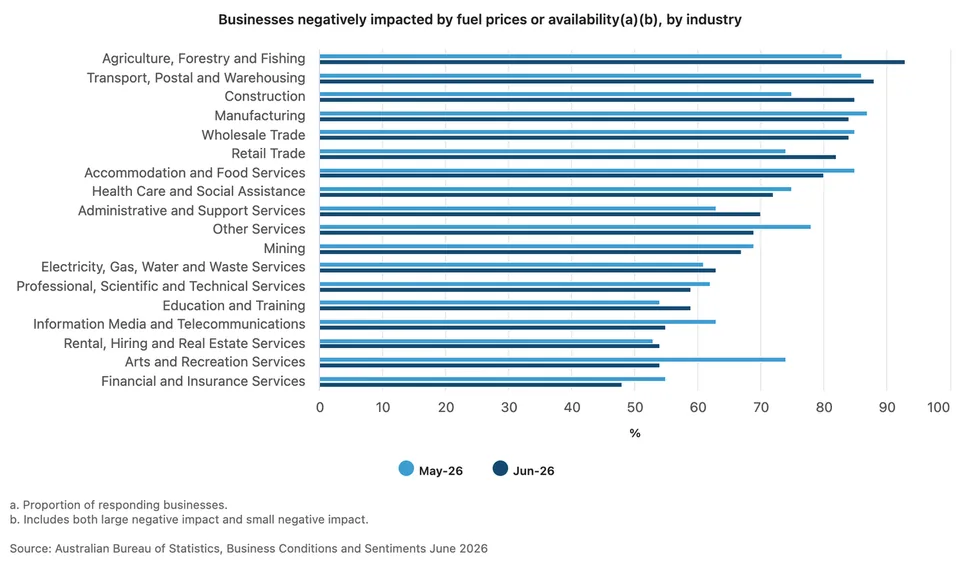
The Australian Bureau of Statistics' final Business Conditions and Sentiments survey provides an unusually useful snapshot of the pressure underneath the insolvency figures.
Figure 1. Businesses negatively impacted by fuel prices or availability, by industry, May–June 2026. (Source: Australian Bureau of Statistics, Business Conditions and Sentiments, June 2026.)
In June 2026:
- 46% of businesses reported increased operating expenses over the preceding four weeks;
- 31% said revenue had decreased;
- 28% expected it to be difficult or very difficult to meet financial commitments over the following four weeks; and
- small and medium businesses were more likely to report difficulty meeting those commitments than large businesses.
Hospitality was particularly exposed.
Among accommodation and food-service businesses, 45% reported falling revenue , while 47% expected difficulty meeting their financial commitments . Some 28% reported reducing the size of their workforce.
This is where a headline about insolvency becomes a management issue.
A company does not suddenly become financially fragile on the day an administrator is appointed.
The deterioration begins earlier.
It begins inside margins.
Inside payroll.
Inside debtor ageing.
Inside tax obligations.
Inside inventory.
Inside contracts priced six months ago.
Inside management decisions that are repeatedly deferred because next month is expected to be better.
$35.9 billion: the number we think business leaders should pay attention to
One of the most significant pieces of Australian small-business data this year did not come from an insolvency report.
It came from the Australian National Audit Office's June 2026 examination of ATO small-business debt.
At 30 June 2025, Australian small businesses held $35.9 billion in collectable tax debt .
That represented 66.1 per cent of the ATO's entire $54.2 billion collectable debt book , despite small businesses contributing a much smaller proportion of total tax collections. There were 1,338,387 small businesses with collectable debt , with an average balance of $26,797 .
The figure has risen dramatically.
Small-business collectable debt stood at $16.5 billion in 2018–19 .
By 2024–25, it was $35.9 billion — an increase of $19.4 billion.
More concerning still, the ANAO identified 39,352 small businesses classified as “disengaged taxpayers” with collectable debts exceeding $100,000, older than 90 days and without active engagement over that debt. Together, those businesses owed approximately $11.3 billion .
That is not just a taxation story.
It is a liquidity story.
The tax account can become a hidden source of working capital
There is a dangerous pattern that can emerge inside a cash-constrained business.
GST is collected.
PAYG withholding accrues.
Superannuation becomes payable.
The cash exists temporarily in the operating account.
But another obligation arrives first.
Payroll.
A supplier.
Rent.
Inventory.
Insurance.
The money is used.
Management plans to replace it next month.
Next month brings another obligation.
Slowly, money belonging economically to a future liability becomes an unofficial source of working capital.
The RBA has specifically identified unpaid tax debt as an important feature of current distress. The share of insolvent companies owing more than $1 million in unpaid taxes increased from around 5 per cent in June 2021 to 9 per cent in June 2025 .
That does not mean tax debt itself causes every insolvency.
It means tax debt can be an extraordinarily useful diagnostic signal .
When recurring operations cannot generate enough cash to simultaneously meet operating and statutory obligations, management may be dealing with something more fundamental than a temporary shortage.
The Studio Orris view: insolvency begins as an information problem
This is where our perspective differs from treating insolvency purely as an end-stage financial event.
Long before formal insolvency, many organisations have an information deficit .
They know revenue.
They know the bank balance.
They may know monthly profit.
But they cannot confidently answer:
- What will our lowest cash position be during the next 13 weeks?
- Which customers actually produce contribution margin after servicing costs?
- What percentage of receivables is more than 30, 60 or 90 days overdue?
- How much of the cash balance already economically belongs to GST, PAYG, superannuation or other liabilities?
- What happens if our largest customer pays 30 days late?
- What happens if revenue falls 10 per cent without an equivalent reduction in overhead?
- Which costs can genuinely be removed within 30 days?
- Where is the break-even point of the company today — not when the annual budget was prepared?
If senior management cannot answer these questions quickly, the problem is not necessarily insolvency.
But it is visibility .
And poor visibility makes every later decision slower.
Growth can accelerate the problem?
One of the most persistent misconceptions in business strategy is that additional revenue automatically resolves financial pressure.
It often does.
But only where the underlying economics are sound.
Consider a company generating $2 million in revenue with inadequate gross margins and poor cash conversion.
Management responds by pursuing $3 million.
To deliver the additional $1 million, the company hires employees, purchases stock, expands premises, pays contractors, increases advertising expenditure and extends credit to new customers.
Revenue increases.
Working-capital requirements increase faster.
The company is now larger.
It may also be less liquid.
This is why we distinguish between growth and scale .
Growth means more.
Scale means that the economics become stronger as there is more.
A company can grow its revenue while simultaneously increasing its probability of financial distress.
Top-line growth cannot compensate indefinitely for broken unit economics.
Interest rates have returned to the equation
The operating environment has also tightened again.
As of September 2026, the RBA cash-rate target sits at 4.35 per cent , following three increases totalling 75 basis points during 2026. The Reserve Bank expects those increases to continue flowing through the economy and slowing demand.
For businesses, higher rates can work through several channels simultaneously.
Finance becomes more expensive.
Customers carrying mortgages have less discretionary income.
Property and investment decisions may be delayed.
Working-capital facilities become more costly.
And valuations based on cheap capital become harder to sustain.
The result is another reason we would resist declaring victory simply because FY2026 insolvency appointments declined by approximately four per cent.
The lag matters.
There is a difference between distress and inevitability
One reason early visibility matters is that external administration does not automatically mean the underlying business must disappear.
ASIC's 2026 review of voluntary administrations examined 5,020 companies entering voluntary administration between July 2021 and June 2025.
Across the grouped appointments studied, 44 per cent entered a Deed of Company
Arrangement , while 50 per cent proceeded into voluntary liquidation. And among approved DOCAs, 49 per cent involved the company's business continuing to trade after the deed was executed .
Australia's Small Business Restructuring regime provides another pathway for eligible companies with liabilities of no more than $1 million , allowing directors to retain control while working with a registered restructuring practitioner on a plan.
ASIC's earlier review found 3,388 small-business restructuring appointments between July 2022 and December 2024, of which 2,820 transitioned into restructuring plans.
The strategic lesson is not that every distressed company can be saved.
It cannot.
The lesson is that timing preserves optionality .
Once cash, stakeholder confidence, supplier support and enterprise value have been exhausted, the available solutions become considerably narrower.
So what should management actually do?
Businesses are already adapting operationally. The response to cost pressure is showing up not only in pricing and procurement, but in workforce design itself. ABS data shows businesses have reduced non-essential travel, cut workforce size, changed rostering arrangements and altered working patterns in response to fuel costs and availability.
Figure 3. Workforce changes made in response to fuel prices or availability, May–June 2026. (Source: Australian Bureau of Statistics, Business Conditions and Sentiments, June 2026.)
At Studio Orris, we would not start with the question:
“Are we going insolvent?”
For most otherwise functioning businesses, that question comes too late.
We would start with:
“Where is resilience being consumed?”
That means examining the business as an interconnected operating system.
Cash visibility. Build a rolling 13-week cash-flow forecast, updated against actual results rather than left as an annual spreadsheet.
Margin integrity. Understand contribution margin by product, customer, service and channel — not simply total gross revenue.
Working capital. Measure debtor days, creditor timing, inventory cycles and statutory obligations together.
Cost architecture. Separate genuinely variable costs from structural overhead and identify what can change under different demand scenarios.
Customer concentration. Model the financial consequence of losing — or simply being paid late by — major accounts.
Pricing power. Determine whether increases in labour, freight, rent or materials are being absorbed indefinitely rather than recovered.
Productivity. Use technology and automation where they remove repeat administrative labour or improve decision quality, rather than introducing technology for its own sake.
The RBA has itself noted small businesses increasingly pursuing cost reduction and productivity improvements, including AI, as they protect margins.
And finally, decision speed .
Management accounts delivered weeks after month-end explain history.
Decision infrastructure should help management understand what happens next.
A stronger company is not simply one that survives
There is a risk that conversations about insolvency set the ambition too low.
Avoiding collapse is not a strategy.
A resilient business should be capable of absorbing volatility while retaining the ability to invest.
To hire.
To innovate.
To market.
To pay suppliers properly.
To respond to opportunities.
And to make decisions without every unexpected expense becoming an existential question.
This is why we regard resilience as a design problem , not simply a finance problem.
Brand strategy matters because pricing power matters.
People strategy matters because labour productivity matters.
Technology matters because operating leverage matters.
Financial visibility matters because timing matters.
Governance matters because somebody ultimately has to make the decision.
These are not separate conversations.
They are the architecture of the same organisation.
The insolvency plateau
The Australian economy does not appear to be entering a universal corporate crisis.
The Reserve Bank's assessment is more measured: most businesses remain financially resilient, and economy-wide insolvency rates have stabilised around longer-run levels.
But the same data also tells us not to become complacent.
14,152 first-time external-administration and controller appointments remain a substantial number.
Construction and hospitality remain disproportionately exposed.
Small-business tax debt has reached $35.9 billion .
More than a quarter of businesses surveyed by the ABS in June reported expecting difficulty meeting near-term financial commitments.
So perhaps the most useful way to understand Australia's insolvency story in 2026 is not as a crisis or a recovery.
It is as a stress test.
Some organisations entered this period with strong margins, disciplined balance sheets, reliable information and room to manoeuvre.
Others entered with little margin for error.
And that leads to the principle we think matters most:
Studio Orris Perspective
Studio Orris works across business strategy, digital and operational systems, brand, marketing and people to help organisations identify structural weaknesses and build stronger foundations for sustainable growth.
Our role is not to replace licensed insolvency, accounting, taxation or legal professionals. Where a company may be insolvent, likely to become insolvent, or is unable to meet debts as they fall due, directors should obtain appropriate professional advice promptly. ASIC likewise encourages directors experiencing financial difficulty to respond early rather than ignore warning signs.
Business Strategy · Studio Orris Intelligence · September 2026
 Return to Insights →
Related Insights

Australia's AI Ambition Is Growing. But Where Is the Return?
Studio Orris · 13 October 2026

Studio Orris Launches Nexus Intelligence™ for Smarter People Decisions
Studio Orris · 10 September 2026

Built Differently, Recognised Locally: Outside the Box Wins at the 2026 Brisbane City Local Business Awards
Studio Orris · 30 August 2026